
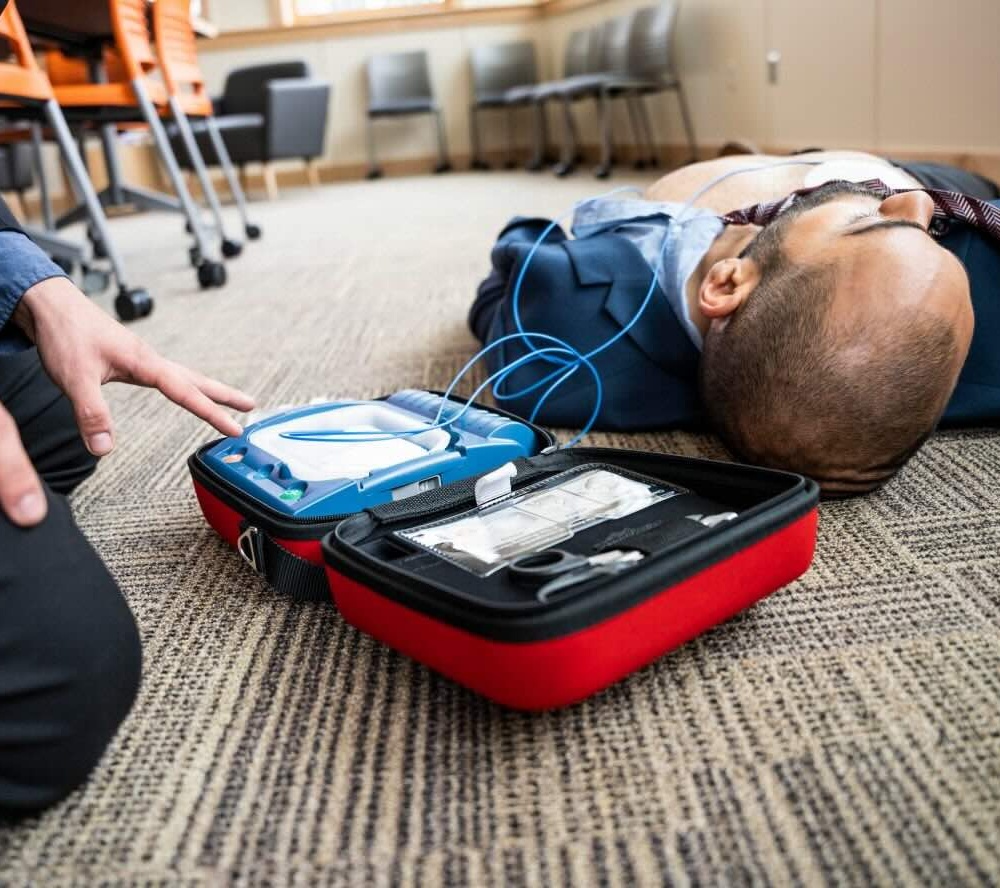
An Automated External Defibrillator (AED) is a portable, life-saving device that analyses heart rhythm and delivers an electric shock to restore normal heartbeat during sudden cardiac arrest (SCA). In Singapore, AEDs are found in HDB blocks, MRT stations, workplaces, condominiums and public spaces — and the network continues to grow through the SCDF’s Save-A-Life initiative.
This guide covers everything you need to know about AEDs in Singapore: how they work, who should install one, which model to choose, maintenance requirements, and how to purchase from a trusted supplier.
What Is an AED (Automated External Defibrillator)?
An AED is a medical device designed for use by non-medical personnel. When a person collapses from sudden cardiac arrest, the heart stops pumping blood effectively. An AED analyses the heart’s electrical activity and, if a shockable rhythm is detected, delivers a controlled electric shock — known as defibrillation — to restore a normal heartbeat.
Modern AEDs are designed to be simple and safe for bystanders to use. Step-by-step voice instructions guide the user through the entire process, including pad placement and when to press the shock button. The device only delivers a shock if it determines one is necessary — making accidental shock to a bystander impossible.
How Does an AED Work? Step-by-Step
Step 1 — Power on: Open the AED case. The device immediately powers on and begins giving voice instructions.
Step 2 — Attach pads: Apply the pre-connected electrode pads to the patient’s bare chest as shown in the diagram on the pads.
Step 3 — Analyse rhythm: Stand clear while the AED analyses the heart rhythm automatically.
Step 4 — Deliver shock (if advised): If a shockable rhythm is detected, the AED charges automatically and instructs you to press the shock button. Stand clear before pressing.
Step 5 — Resume CPR: After the shock (or if no shock is advised), immediately resume CPR as instructed by the device.
Why AEDs Matter in Singapore
Sudden cardiac arrest is one of the leading causes of death in Singapore. Unlike a heart attack (which is a blockage), SCA is an electrical malfunction of the heart — it can strike anyone, anywhere, at any time, including people with no prior heart condition.
Survival rate drops by 7–10% for every minute without defibrillation. With average SCDF ambulance response times of 8–11 minutes in Singapore, early access to a nearby AED can make the difference between life and death. CPR alone can sustain circulation, but defibrillation is the definitive treatment for shockable cardiac rhythms.
This is why SCDF’s Save-A-Life initiative has deployed AEDs at HDB lift lobbies across all 89 constituencies, and integrated AED locations into the myResponder app — allowing trained bystanders to locate and retrieve a nearby AED while responding to an SCA incident.
Is an AED Mandatory in Singapore?
It is currently not mandatory for private or public building owners to install AEDs on their premises. However, the SCDF and Singapore Heart Foundation (SHF) actively encourage businesses and building management to install AEDs and register publicly accessible units with the national AED registry.
That said, AED installation is closely aligned with several compliance and best-practice frameworks in Singapore:
- Company Emergency Response Team (CERT) requirements under SCDF — CERT-equipped workplaces are expected to include AED as part of their emergency response kit
- Workplace Safety and Health (WSH) Act — employers have a duty to maintain a safe workplace; AED is increasingly considered part of emergency preparedness for higher-risk environments
- MCST and condominium management best practices — many MCSTs install AEDs in common areas as part of resident safety obligations
- Tender and facility management specifications — many government and institutional premises specify AED provision in their facility management contracts
Even where not legally required, the presence of a registered, maintained AED is a strong signal of duty-of-care and emergency readiness — which is increasingly expected by tenants, employees, insurers and auditors.
Who Should Install an AED in Singapore?
| Premises Type | Key Risk Factor | Recommended Model |
| Offices and commercial buildings | High footfall, sedentary workers | Philips HS1 |
| Condominiums (MCST) | Elderly residents, common areas, children | Philips HS1 or FRx |
| Factories and warehouses | Physical labour, industrial exposure | Philips HS1 |
| Gyms and fitness centres | High exertion, cardiac risk elevated during exercise | Philips HS1 or FRx |
| Schools and childcare centres | Staff cardiac risk, public duty of care | Philips FRx |
| Hotels and dormitories | Large population, diverse age groups | Philips HS1 or FRx |
| CERT-equipped facilities | Emergency response readiness required | Philips HS1 |
AED Models Available in Singapore: Philips HS1 vs FRx
Fiready supplies two trusted Philips HeartStart AED models — the HS1 and the FRx. Both are designed for use by non-medical personnel and carry an 8-year manufacturer warranty on the main device from date of manufacturing.
Philips HeartStart HS1
The HS1 is the most widely deployed AED in Singapore workplaces, condominiums and public buildings. It is compact, lightweight and designed for immediate use by anyone — even those with no prior AED training. Key features include:
- SMART Analysis technology automatically analyses heart rhythm
- Pre-connected SMART Pads for fast deployment
- Adaptive shock energy up to 360 joules
- Guides users with clear, calm voice instructions
- 8-year device warranty (from date of manufacturing); battery life approximately 4 years; pad shelf life approximately 2 years
Philips HeartStart FRx
The FRx is suitable for both adult and child use and can be used on both metal and wet surfaces. Key features include:
- Same SMART Analysis and adaptive shock energy as the HS1
- Child key available which means you only need 1 pad for both adult/child use
- Robust casing for demanding environments
- 8-year device warranty
AED Maintenance Requirements in Singapore
An AED is only effective if it is properly maintained and ready for immediate use. Neglecting maintenance — particularly expired pads or batteries — can render the device ineffective in an emergency. This is a key reason to engage a professional AED maintenance provider.
| Component | Action Required | Frequency | Notes |
| AED Device | Annual inspection & servicing | Yearly | Servicing certificate issued for compliance records |
| Electrode Pads | Replace before expiry or once used. | ~2 years | Check expiry date printed on pad packaging |
| Battery | Replace before expiry | ~4 years | Monitor device status indicator for prompts |
| Self-Test (auto) | Device runs automatic checks | Daily / periodic | Audible / visual alert if issue detected |
| Cabinet & Signage | Visual check for damage or obstruction | Monthly | Ensure AED is accessible and unobstructed |
Fiready provides comprehensive AED maintenance services in Singapore, including routine inspection, pad and battery replacement, annual servicing, and maintenance documentation. Upon completion of each service, a servicing certificate is issued — useful for workplace safety audits, CERT documentation and insurance purposes.
AED and CPR: Using Them Together
An AED works most effectively when combined with CPR (Cardiopulmonary Resuscitation). The correct emergency response sequence for a suspected SCA victim is:
- Call 995 (SCDF) immediately.
- Begin CPR — 30 chest compressions followed by 2 rescue breaths. If untrained, hands-only CPR (compressions only) is acceptable.
- Retrieve and attach the nearest AED — use the myResponder app to locate the nearest AED if one is not on-site.
- Follow AED voice instructions — the device will guide you step by step.
- Continue CPR and AED cycles until SCDF paramedics arrive.
How to Buy an AED in Singapore
When purchasing an AED in Singapore, consider the following:
1. Choose the Right Model for Your Environment
For industrial sites, factories, warehouses, offices and CERT teams, the Philips HS1 is the most appropriate choice. For childcare and schools, the Philips FRx’s is the preferred model.
2. Include Cabinet and Signage
An AED should be stored in a clearly marked wall-mounted cabinet with visible AED signage. This ensures first responders and bystanders can locate the device quickly. Fiready supplies and installs AED cabinets as part of our full AED package.
3. Choose an Authorised Supplier
Purchase from an authorised Philips AED supplier in Singapore to ensure genuine devices, valid warranties and reliable after-sales support. Fiready is an experienced fire safety and emergency equipment specialist with a strong track record supplying AEDs to commercial clients across Singapore.
Frequently Asked Questions — AED Singapore
Can anyone use an AED in Singapore?
Yes. AEDs are designed for use by non-medical personnel. The Philips HeartStart HS1 and FRx both provide step-by-step voice instructions that guide any bystander through the process. While CPR + AED training is strongly recommended, you do not need medical qualifications to operate a Philips HeartStart AED.
How long do AED pads and batteries last?
Electrode pads have a shelf life of approximately 2 years from the date of manufacture. The AED battery lasts approximately 4 years under standby conditions. Both should be replaced before expiry. Expired pads or batteries may not function reliably during a cardiac emergency. Pads must be replaced once used.
What is the warranty on a Philips AED in Singapore?
Philips HeartStart AED devices carry an 8-year manufacturer’s warranty from the date of manufacture on the main device. The warranty excludes consumable components such as electrode pads and batteries, which require regular replacement.
Does an AED need annual servicing in Singapore?
While Philips AEDs perform automatic self-tests, annual professional servicing is recommended to ensure the device remains in optimal working condition and to maintain compliance documentation. Fiready provides annual AED servicing with a servicing certificate issued upon completion.
How do I register my AED with the national AED registry?
You can register publicly accessible AED locations with the Singapore Heart Foundation by emailing R-AEDi@scdf.gov.sg. Registration ensures your AED is visible on the SCDF myResponder app, maximising its availability to first responders in the area.
Does my CERT setup need an AED?
Yes. AED is a standard component of the Company Emergency Response Team (CERT) equipment kit under SCDF guidelines. CERT-equipped workplaces are expected to include at least one AED as part of their emergency response capability. The Philips HS1 is the preferred model for CERT teams.
AED Singapore Supply, Installation and Maintenance — Fiready Pte Ltd
Fiready is a trusted fire safety and emergency equipment specialist in Singapore. We provide end-to-end AED solutions for workplaces, condominiums, schools, factories and commercial buildings.
- Supply of Philips HeartStart HS1 and FRx AEDs
- Professional cabinet installation and signage
- Basic AED training for staff and CERT teams
- Annual servicing with servicing certificate
- Battery and pad replacement
Contact Fiready today for a free consultation and customised quotation.
Website: www.fireadysg.com
Product page: www.fireadysg.com/product/automated-external-defibrillator-aed-singapore/